

Losing your balance is not simply getting older.
Balance is a skill your body maintains from three inputs plus the strength to act on them: the inner ear, your vision, and the sensation coming up from your feet and joints. Age, months of sitting, a medication change, or a neurological condition can degrade any of those, and the loss is gradual enough that most people adapt without noticing. They stop walking the dog at dusk. They take the elevator. They hold the rail with both hands.
Parkinson’s disease changes how movement is started and scaled, which shows up as shorter steps, a stooped posture, and turns that take several small steps. Stroke can leave weakness, altered muscle tone, and sensory loss on one side that reshapes the whole walking pattern. Both respond to specific, repeated, progressively harder practice. So does the far more common case: an adult who quietly stopped challenging their balance years ago.
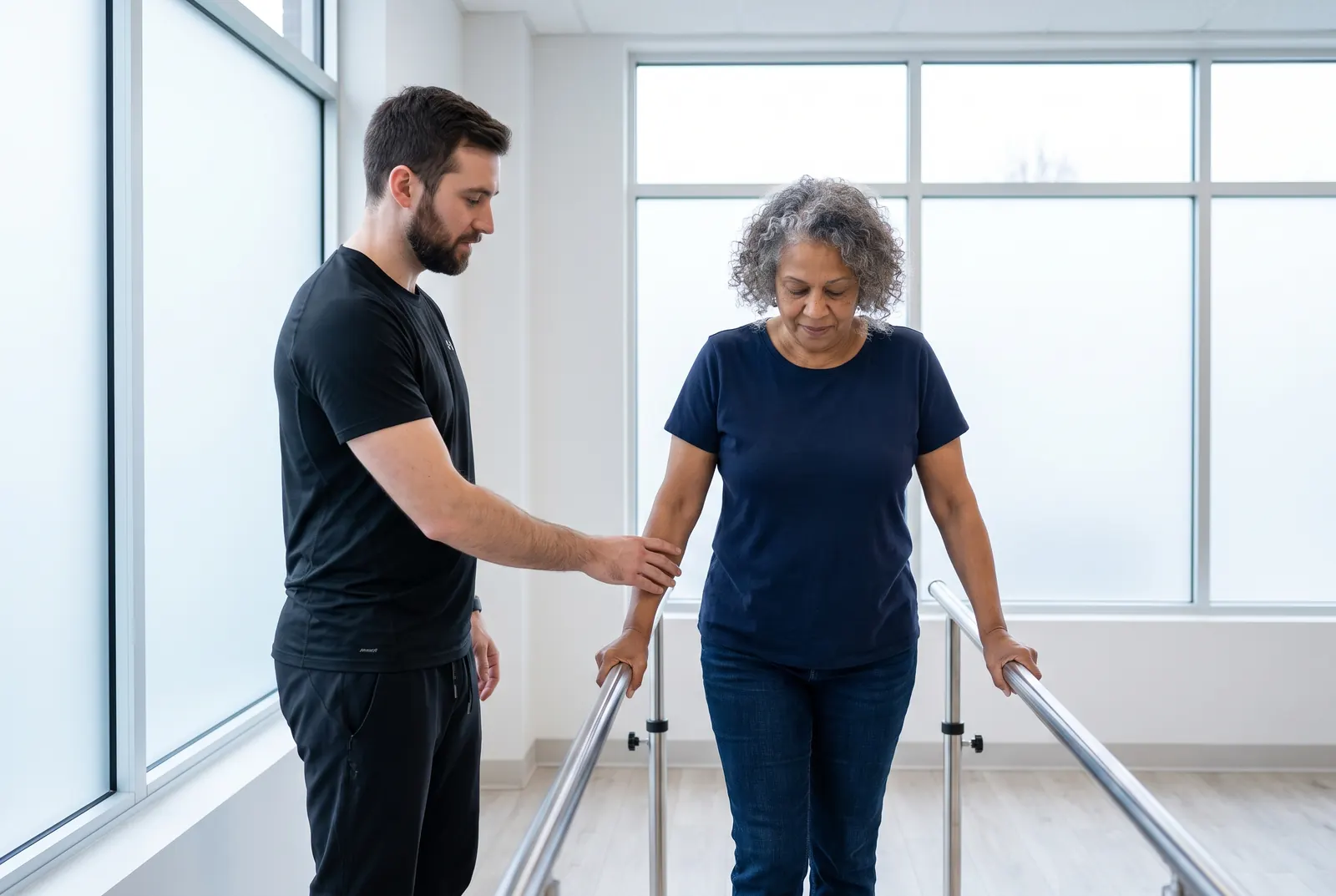
The signs people explain away.
Most of these get put down to being tired or clumsy. They are measurable instead, and measurable things can be trained.
Reaching for Walls and Furniture
Touching a wall, a counter, or the back of a chair to cross a room, especially at night or in low light.
Shorter, Shuffling Steps
Step length quietly shrinking, feet not clearing the floor, and turns that take four or five small steps instead of one.
Fear of Falling
You have already changed what you do: fewer stairs, no ladders, nothing uneven, no walking once it is dark.
A Near Fall, or an Actual One
A stumble you caught, or one you did not. Either is reason enough to have your balance tested rather than watched.
One Side That Will Not Cooperate
Weakness, heaviness, or numbness on one side after a stroke, changing how you push off and how you land.
Unsteady on Uneven Ground
Grass, gravel, curbs, and ramps feel far harder than a flat floor, so you plan routes around them.
Balance gets trained, not advised.
Telling an adult to be careful is not treatment. Your physical therapist tests each input on its own: how you balance with vision removed, on a soft surface, while turning your head, and while your hands are busy with something else. That sorts out whether the problem is the inner ear, the sensation from your feet, the strength that has to catch you, or the confidence that has drained away around all three.
Then we train the specific failure, progressively, at a level that is genuinely hard for you, because that is the only level at which balance improves. Dr. Mary Ninivaggi, PT, DPT, ATC, AIB-VRC works on dynamic balance: the kind you need while turning, reaching, and walking, not the kind you only have standing still. Hip and ankle strengthening goes in alongside it, because balance you cannot act on is not balance.
No referral needed. Most insurances accepted. Doors open at 5:00 AM, so you can be seen before work.
What our patients say.
"I have been attending physical therapy at Carroll Physical Therapy and have had an excellent experience. I initially worked with Luke, who was outstanding."Marjorie H. · Google Review
Schedule Your Appointment
No referral needed. Most insurances accepted. Doors open at 5:00 AM.
Your first visit is a full one-on-one evaluation: come in, tell us everything, and leave with a plan.
* Required field
You’re all set.
We’ll reach out within one business day to confirm your appointment. If you need to speak with us sooner, call us directly.