

The elbow hurts. The cause is usually not the elbow.
Tennis and pickleball punish the same few places: the outside of the elbow, the front of the shoulder, the hip and knee on the pivot side, and the calf and Achilles on the push-off. What they have in common is that the painful tissue is almost never where the problem started. A shoulder that will not rotate makes the elbow absorb the swing. A stiff hip makes the low back rotate instead. Slow footwork means you reach for a ball you should have moved to, and the arm pays for it.
Pickleball has changed the mix locally. Courts are everywhere in Morris County, the game is easy to start and hard to stop, and it brings people back to sport after years off, often three or four sessions a week from a standing start. The paddle is lighter than a racquet but the game is played closer, quicker, and lower, so we see more calf and Achilles strains, more sudden ankle and knee injuries, and more overuse in shoulders that had not gone overhead in a decade.
So we treat the painful tissue and the chain behind it. You get the mechanical reason your elbow flared in plain language, and a plan that keeps you on the court while it settles wherever that is reasonable. Full stop from play is a last resort here, not a first instruction.
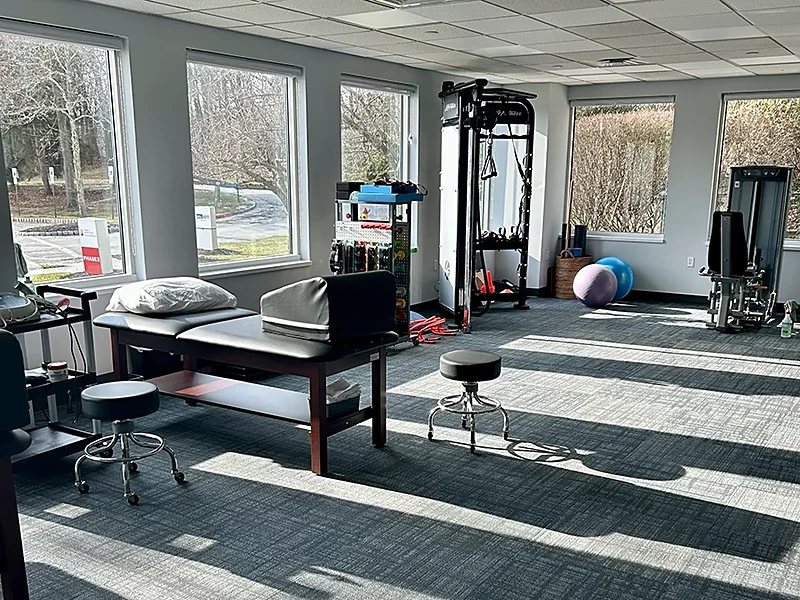
The injuries that come off the court.
Six patterns account for most of what walks in from tennis and pickleball, and each one points at a different link in the chain.
Tennis Elbow
Pain on the outside of the elbow with backhands, gripping a paddle, or lifting a coffee cup the next morning.
Shoulder Pain Serving or Overhead
A pinch at the front or top of the shoulder on the serve or the overhead, with power that fades late in a match.
Calf and Achilles Pain
Soreness or a sudden sharp pull in the calf pushing off for a drop shot, one of the most common pickleball injuries we see.
Knee Pain with Lunging
Pain at the front of the knee on split steps, lunges to the net, or getting low for a dink.
Hip and Groin Tightness
Deep hip or groin pain on the pivot side, usually the first sign that rotation is coming from the wrong place.
Low Back Stiffness After Playing
A back that locks up the evening after a match, common when the hips and mid-back have stopped rotating and the lumbar spine covers for both.
Prevention and performance enhancement, not just pain relief.
Getting the pain out is phase one. It is not the finish line. Once the irritated tendon has calmed, we screen the things that put load in the wrong place: shoulder rotation, mid-back and hip mobility, single-leg control, calf capacity, and how you actually move your feet to the ball. Then we build those, because the same swing through a body that rotates properly does not injure the elbow.
Loading is progressive and specific. Grip and forearm work for the elbow, rotator cuff and scapular control for the serve, calf and Achilles capacity for the push-off, and change of direction work for the lateral demand both sports live on. Our sports rehab program takes it the rest of the way, from pain-free to playing three times a week without paying for it on Monday.
No referral needed. Most insurances accepted. Doors open at 5:00 AM, so you can be seen before work or before a morning match.
What our patients say.
"I really appreciated the care I received at Carroll Physical therapy in Denville. My physical therapist Luke was outstanding. His thorough and compassionate care aided in my recovery."Anjelica S. · Google Review
Schedule Your Appointment
No referral needed. Most insurances accepted. Doors open at 5:00 AM.
Your first visit is a full one-on-one evaluation: come in, tell us everything, and leave with a plan.
* Required field
You’re all set.
We’ll reach out within one business day to confirm your appointment. If you need to speak with us sooner, call us directly.